

May Season Studio Archives
by Gintare O.
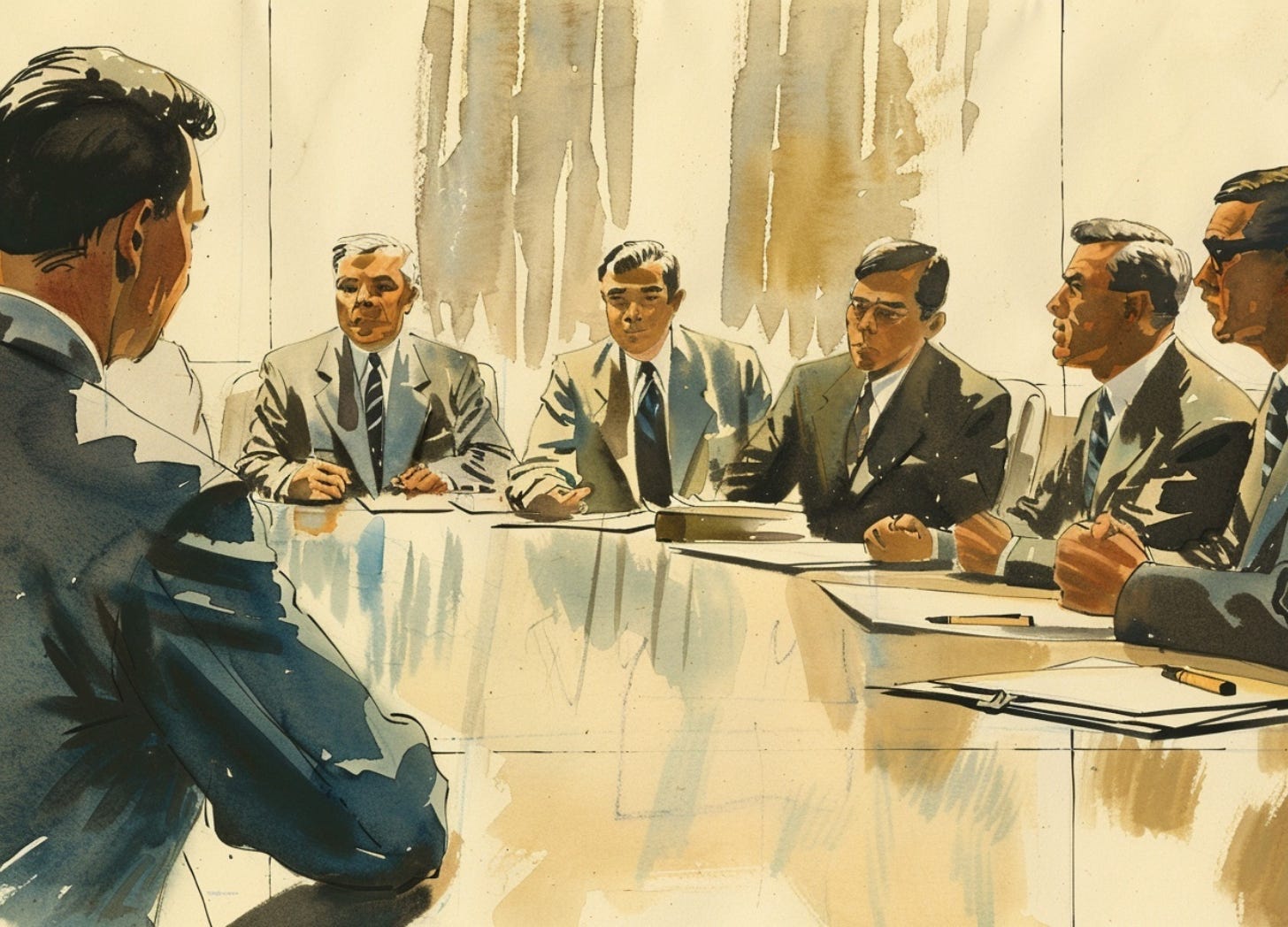
When Elias entered the executive conference room, no one looked surprised to see him.
That was the first thing that told him this was finished.
Legal was already seated. Not clustered. Not whispering. They had spread themselves out along one side of the table, documents arranged neatly, each stack aligned with a specific jurisdiction. Corporate Security occupied the far end, posture alert but neutral, hands folded, eyes steady. Risk Oversight had brought printed materials. That, more than anything else, told Elias this was not exploratory. Printed materials meant conclusions had already been reached.
The door closed behind him with a soft seal.
“Thank you for joining us,” someone said.
It might have been the COO. Elias couldn’t tell. At this level, voices flattened. Authority became a collective tone rather than a person.
A document slid across the table toward him.
It wasn’t the incident report.
It wasn’t the Compact’s response.
It was a summary.
Unauthorized sequencing adjustment
Contractual breach with a protected covenant client
Confirmed loss of Compact disease-regulation asset
Invocation of consequence clause
Elias didn’t pick it up right away. He read it where it sat, eyes moving faster than the words wanted him to. He noticed the font was slightly larger than standard internal memos. Someone had adjusted it for readability. He wondered who.
“You pulled revenue forward,” Legal said.
Not accusatory. Just factual. The way people speak when blame has already been categorized.
“Yes,” Elias said. His voice sounded distant to him. Like it belonged to someone else in the room. “Within allowable discretion.”
“That discretion does not apply to this client,” Corporate Security said.
“It never has,” Risk Oversight added, almost gently.
Elias nodded once. He wasn’t going to argue that point. He had already argued it with himself and lost.
“The Compact has declined remediation,” Legal continued. “They have also declined negotiation.”
“Of course they have,” Elias said quietly.
No one contradicted him.
There was a pause, long enough to allow for something emotional to surface. Nothing did.
“They are enforcing consequences,” the COO said.
No one explained what that meant. They didn’t need to. Elias understood now what the Compact had lost.
Not revenue.
Not access.
Not time.
They had lost a regulator.
A biological stabilizer embedded deep within their internal health systems. Something old and carefully maintained. Something that consumed excess viral load and moderated immune overreaction. Not a cure. A balance.
MSS had helped supply the Compact for decades because containment was easier than crisis. Regular deliveries allowed them to run quiet vaccination cycles, manage outbreaks internally, and prevent spillover into the broader population. It wasn’t charity. It was coexistence.
Without the regulator, the Compact’s disease environment would overcorrect.
Exposure without control.
Infection without mitigation.
Spread without warning.
The deaths would not be symbolic.
“They are holding MSS accountable,” the COO said. “Not financially.”
Elias swallowed. His throat felt dry in a way water wouldn’t fix.
“They’ve named you,” Corporate Security said.
The room stayed quiet, allowing that sentence to settle.
“Not as a scapegoat,” Legal clarified. “As a responsible party. Under covenant language you personally executed.”
Elias thought of the call. The phrasing. The confidence. The smile no one had seen.
“You should have known better,” someone said.
It wasn’t cruel. It wasn’t angry. It was simply accurate.
Elias nodded again. His body had stopped reacting ahead of his thoughts now. Everything was catching up in order.
“What happens now?” he asked.
The answer came in pieces.
MSS would not terminate him. Termination implied error. Error implied liability. MSS did not make mistakes at this level. It made decisions.
MSS would not shield him. Shielding implied ownership of consequence. The covenant did not allow transfer.
Instead, MSS would comply.
They would provide access.
They would provide location data.
They would provide Elias Mercer.
Not as punishment.
As fulfillment.
The Compact did not want spectacle. They did not want revenge. They wanted equilibrium restored. They wanted a life of comparable weight to the one they had lost. Someone embedded. Someone who mattered just enough to count, but not enough to destabilize MSS itself.
Corporate Security slid another document across the table.
This one was thinner. Cleaner.
Temporary reassignment
Immediate leave from public-facing duties
Movement restrictions pending handoff
Elias read it once. Then again.
Compliance timeline: seventy-two hours.
He leaned back in his chair, finally allowing the weight of it to settle fully. Not because of the meeting. Not because of the screaming. But because the number had hit.
The quarter had closed.
Everyone had been paid.
Bonuses distributed. Forecasts reset. Investor calls completed without incident.
Outside the conference room, his team was already planning next quarter. Someone was updating a slide deck. Someone else was drafting a congratulatory email they would never send. They were unaware that the cost had not been avoided, only delayed.
Elias stood.
“I’ll cooperate,” he said.
No one thanked him. Cooperation was assumed.
He walked out of the room and back through the hallway that suddenly felt longer than it had that morning. The building hummed. Elevators chimed. Someone laughed near the coffee station.
Normal continued.
Back in his office, he packed slowly. Not because he needed to. Corporate Security would inventory everything later anyway. He removed personal items because the act of choosing felt important.
A framed photo from a conference in Prague.
A book he had never finished.
A jacket he kept because it made him look less senior than he was.

He left the rest.
When he shut the door, the glass did not tint. That privilege had already been revoked.
As he walked toward the elevators, his phone buzzed.
An automated message.
Compliance window initiated.
Instructions forthcoming.
He did not reply.
Outside, the city moved the way it always did. Cars. Pedestrians. Delivery trucks unloading boxes that would be logged, scanned, and moved without thought.
MSS signage glowed on the side of the building, clean and reassuring.
Elias Mercer stepped into the elevator and let the doors close.
He had fixed the quarter.
That would be the line people remembered.
Everything else would be archived.
AUTHOR’S NOTE
Some decisions resolve numbers and defer everything else. This entry documents the point at which accountability shifted from abstract risk to a named individual, and where corporate compliance functioned exactly as designed.
Closure, in this case, was procedural.
written and designed by gintare okrzesik, creator of may season studio — a fictional corporation exploring beauty, bureaucracy, and quiet corruption through narrative design.
Filed under: May Season Studio Internal Records Part III
This report is part of an ongoing file. Additional entries follow.


Oh, Elias! We barely knew you.