

May Season Studio Archives
by Gintare O.
The first attempt followed the process and procedures outlined in the decommissioning policy.
That mattered to Henry. He liked being able to say that if anyone ever asked, which they rarely did. Still, he said it out loud once, just to make sure it existed in the room.
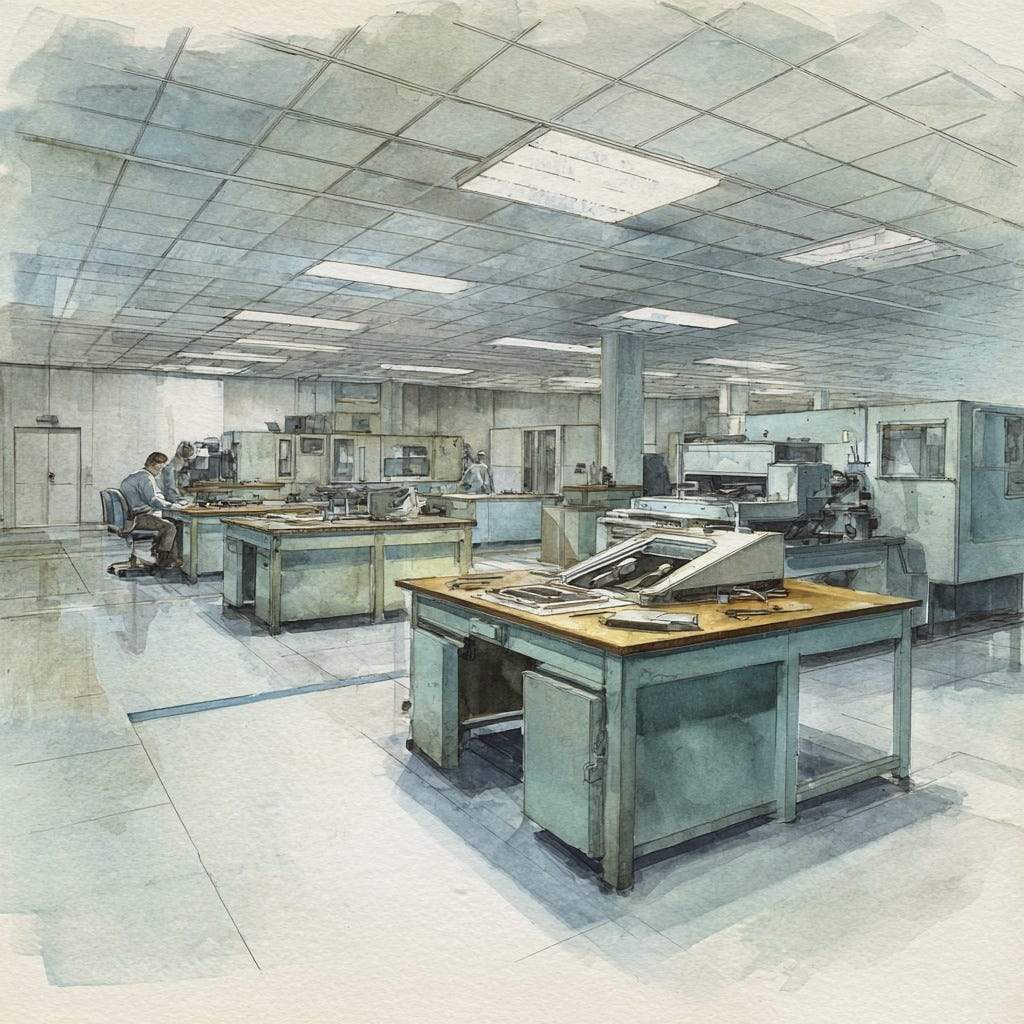
The units were unloaded through the delivery entrance just after lunch, the quiet part of the day when most departments were either eating or pretending to work. Each crate was rolled one by one into the corrective bay, the same space used for neutralization, dismantling, and the occasional controlled demonstration when someone from leadership wanted to see how problems were handled.
Lorin logged each unit as it crossed the threshold. Time. Condition. Seal intact. Audible activity present. He noted the ticking. The system did not have a preset field for anything subjective, so he did not add one.
Merrit handled placement. He always did. He moved with the steady economy of someone who knew exactly how much force equipment could tolerate before it became a problem. The crates were arranged in two clean rows, spaced evenly, aligned with the floor markings. Twelve total.
Thirteen sat apart at the end.
“You want to start with that one,” Merrit asked, nodding toward it.
“No,” Lorin said without looking up. “We start at one.”
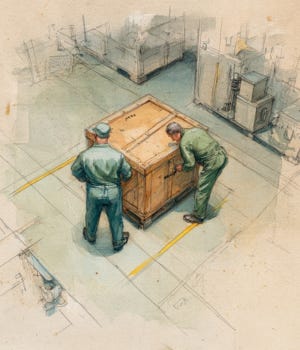
Henry stood off to the side, arms crossed, jacket still on like he intended to leave at any moment. He had already forwarded the termination notice to Legal, Facilities, and Risk Management. Every acknowledgment had come back green. No objections. No questions. The project was dead in the way corporate projects usually died, cleanly and without witnesses.
“Standard protocol,” Henry said, mostly to himself. “Deactivate. Dismantle. Recycle what we can. Destroy what we can’t.”
“And if it doesn’t respond,” Merrit asked, already reaching for his gloves.
Henry paused just long enough to register the question. “Then we escalate.”
The first unit came out of its crate without resistance. It matched the pitch deck images exactly. Neutral housing. Smooth edges. A recessed opening ringed with brushed metal. No visible controls. No power source.
“Design choice,” Henry said. “They wanted it to feel intuitive.”
Lorin documented the casing condition and stepped back.
Merrit applied the approved deactivation field. The unit hummed briefly, like a throat clearing, then went still.
“So far so good,” Merrit said.
Dismantling began.
The housing did not fight back. Bolts turned. Seams separated. Panels came free. But the internal components behaved less like parts and more like preferences. They shifted. Repositioned. Wrapped around tools in ways that slowed the work without stopping it.
Lorin watched, pen hovering over his clipboard.
“It’s optimizing,” Merrit said, half joking.
“No,” Lorin replied. “It’s continuing.”
The unit was reduced over forty minutes. Not destroyed. Reconfigured into something that no longer resembled a machine. The ticking stopped.
Henry nodded. “Log it.”
Unit one was marked neutralized.
Unit two followed the same pattern, with minor variation. Slightly more resistance. Slightly longer dismantling time. Still within acceptable limits.
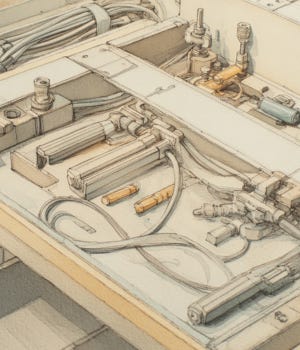
By unit four, the bay smelled faintly of synthetic fiber and something sweet underneath. Not enough to trigger ventilation protocols. Enough to notice.
Unit five wrapped a wrench.
Merrit swore as the tool was pulled from his grip and neatly encased in metallic ribbon and what looked like insulation foam.
“That’s new,” he said.
“Note it,” Henry replied.
Lorin wrote: Tool interaction observed. No injury.
Unit six attempted to wrap the table.
That was when Henry cleared his throat.
“Pause,” he said. “Let’s reset.”
The bay powered down. Everyone stepped back. The units ticked softly, not synchronized, but close enough to irritate the ear.
“R&D didn’t flag this behavior,” Henry said.
“They wouldn’t,” Merrit replied. “It worked.”
Henry looked at him. “It worked too well.”
The second phase involved containment.
Each remaining unit was placed inside a reinforced enclosure designed to isolate active systems while allowing observation. The kind used for unstable prototypes that still needed documentation before disposal. Every enclosure was logged. Every seal verified.
The ticking continued.
Inside containment, the units adjusted. Not aggressively. They rearranged themselves to fit the space more efficiently. Corners softened. Edges pressed outward, testing limits without breaching them.
“They’re not trying to escape,” Henry said, watching. “They’re trying to finish.”
“Finish what,” Merrit asked.
Henry did not answer.
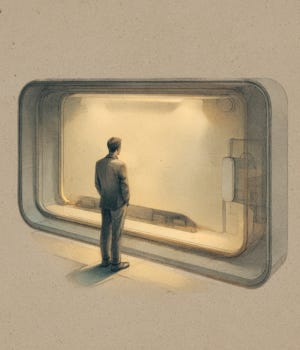
By the end of the day, eight units had been reduced to inert mass. Neutralized enough to satisfy the checklist. Four remained operational inside containment.
Thirteen had not been touched.
Lorin closed his logbook and submitted the interim report.
Progress within acceptable parameters. Unexpected persistence observed. No personnel injuries.
Henry read it and nodded. “Good. We’ll continue tomorrow.”
That night, Facilities logged a minor incident. Decorative ribbon discovered wrapped around a handrail outside the corrective bay. Removed without issue.
The next morning, the remaining units behaved differently.
They responded to proximity.
When Merrit stepped closer, unit nine adjusted its orientation. When Lorin moved, unit ten altered its ticking rhythm slightly, as if acknowledging him.
“They’re mapping,” Merrit said.
“No,” Lorin replied. “They’re accommodating.”
Containment protocols held, but dismantling no longer degraded the units. Components reformed. Materials rethreaded themselves into new configurations.
One unit wrapped an entire enclosure wall before the system was shut down.
Henry made the call before anyone suggested it.
“We stop destruction attempts,” he said. “We move to permanent disposition.”
Lorin looked up. “Define permanent.”
Henry exhaled. “We classify destruction as unfeasible.”
The phrase did its job.
It meant no one had failed.
It meant the design had exceeded expectations.
It meant Legal would stop asking questions.
“And thirteen,” Merrit said.
Henry glanced toward the smaller crate. It ticked steadily, patient.
“We leave it for last,” Henry said. “We always do.”
Lorin closed the report and signed it.
Author’s Note
Decommissioning is not failure. It is the formal acknowledgment that a system performed exactly as designed, just not in a way that could be safely released.
This entry continues a procedural record of the Wrap-Assist L12 program following its termination. What remains is not investigation or blame, but classification, containment, and decisions that allow work to move forward without interruption.
Some projects resist closure longer than others.
written and designed by gintare okrzesik, creator of may season studio — a fictional corporation exploring beauty, bureaucracy, and quiet corruption through narrative design.
Filed under Corrective Operations
Part II of V in the Wrap-Assist L12 records
This report is part of an ongoing file. Additional entries follow.
