

May Season Studio Archives
by Gintare O.

Transcript: Human Resources Exit Review
Location: Conference Room 4B, Surface Operations Tower
Recording Authorized, Archived Under Compliance Code 17.3
HR Representative: For the record, please state your full legal name and current division.
Employee: Daniel Kessler. Surface Division, Content Architecture.
HR: Thank you, Daniel. You submitted a voluntary separation request through WorkPath at 08:12 this morning. I am required to confirm that this request was initiated by you and not suggested by management, Compliance, or Risk.
Employee: It was me.
HR: And you understand this meeting is recorded, transcribed, and stored in both Human Capital archives and Narrative Oversight systems.
Employee: Narrative Oversight?
HR: Standard cross-department routing.
Employee: Right.
HR: Please describe your reason for departure.
Employee: I’ve been here eight years. I think it’s time to move on.
HR: Move on to a comparable organization within lifestyle governance, or to a non-aligned industry?
Employee: I don’t know yet.
HR: Uncertainty is acceptable. We simply document trajectory risk.
Employee: Trajectory risk.
HR: Yes. When employees exit Surface Division without clear landing points, narrative unpredictability increases by 12 to 18 percent.
Employee: I’m just resigning.
HR: Correct. From payroll.
Employee: That sounds like there’s a second part.
HR: There is always a second part.
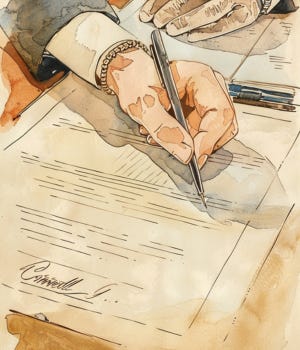
HR shuffles a printed agreement across the table. The paper is thicker than normal printer stock.
HR: You signed the Narrative Continuity Clause during your last promotion cycle. That clause extends beyond employment.
Employee: It’s an NDA.
HR: It is not only an NDA. It is an Alignment Covenant.
Employee: I don’t remember that wording.
HR: Most employees do not. The language is standardized.
Employee: So what does it mean.
HR: It means that while you may terminate your salaried position, your obligation to preserve previously stabilized narratives remains active.
Employee: That sounds abstract.
HR: It is intentionally precise.
Employee: Can you translate that into something human.
HR: You cannot publicly contradict the reality structures you helped construct.
Employee: Reality structures.
HR: Yes.
Employee: I wrote campaign copy and timing frameworks.
HR: You sequenced three regional sentiment corrections, coordinated with Compliance during the Midwest Surface Corridor adjustment, and participated in post-incident framing following a destabilization event.
Employee: You mean the State Street coverage.
HR: I am not authorized to use geographic shorthand.
Employee: That event.
HR: Yes.
Employee: I did my job.
HR: That is correct.
Employee: So why does that follow me.
HR: Because narrative architecture does not dissolve when payroll changes.
Employee: That’s not how jobs work.
HR: That is how alignment works.
Employee leans back in the chair. The chair makes a soft mechanical click against the floor bolts.
Employee: Let me ask this differently. Am I allowed to resign.
HR: Yes.
Employee: Fully.
HR: Administratively.
Employee: And non-administratively.
HR: Your Surface badge will deactivate at 17:00. Your email will transition to archival. Your benefits will conclude at the end of the month.

Employee: And?
HR: Your alignment status will convert from Active Contributor to Extended Affiliate.
Employee: I have never heard that term.
HR: It is rarely needed.
Employee: What does Extended Affiliate mean.
HR: It means your public-facing narrative output remains subject to review if misalignment is detected.
Employee: Review by who.
HR: Compliance. Risk. Cross-Jurisdiction Monitoring.
Employee: You’re talking like I’m some kind of threat.
HR: Not a threat. A variable.
Employee: I am not planning to publish anything.
HR: Most individuals who destabilize narrative cohesion do not plan to.
Employee: This is insane.
HR: It is procedural.
HR taps the folder lightly.
HR: You also initialed Section 12C. Cross-Layer Exposure Acknowledgment.
Employee: I don’t remember that.
HR: You accessed Underground-adjacent datasets during the Corridor event.
Employee: That was performance data.
HR: It was cross-layer performance data.
Employee: So what.
HR: Cross-layer exposure increases post-departure monitoring requirements.
Employee: Monitoring.
HR: Passive, unless triggered.
Employee: Triggered by what.
HR: Deviations in tone. Public contradiction of stabilized accounts. Language clusters associated with drift.
Employee: You are telling me I can’t even talk about my experience.
HR: You may discuss your tenure. You may list your title. You may describe your responsibilities in alignment with approved public language.
Employee: Approved by who.
HR: The system.
Employee: That’s not an answer.
HR: It is the most accurate one.
There is a faint hum from the overhead lights. Daniel glances at the phone placed face-down in the center of the table. It is not his.
Employee: Has anyone actually left.
HR: Many employees transition.
Employee: And they’re fine.
HR: Fine is subjective.
Employee: Have any of them challenged the clause.
HR: Once.
Employee: And.
HR: Their narrative output was recalibrated.
Employee: What does that mean.
HR: It means their public framing shifted.
Employee: Because they chose to.
HR: Eventually.
Employee: You’re not threatening me.
HR: I am clarifying scope.
Employee: You’re making it sound like the company owns reality.
HR: The company maintains alignment within Surface jurisdiction.
Employee: And Underground.
HR: Underground jurisdiction does not recognize resignation.
Employee: That’s not funny.
HR: It is not intended to be.
Employee: I don’t work Underground.
HR: You participated in containment coordination. That qualifies as cross-layer interaction.
Employee: For one quarter.
HR: Duration is less relevant than exposure.
Employee: So if I leave and write a novel about corporate dysfunction.
HR: Fiction is permissible.
Employee: As long as it aligns.
HR: As long as it does not destabilize established sequence.
Employee: Established by who.
HR: The collective stabilization process.
Employee: You mean the company.
HR: I mean cohesion.
Silence.
Employee: What happens if I ignore this.
HR: Non-compliance initiates review.
Employee: Review by who.
HR: Surface first. Underground if necessary.
Employee: Necessary for what.
HR: To preserve continuity.
Employee: That sounds like something you’d say in a war room.
HR: We do not use that term.
Employee: Of course you don’t.
HR closes the folder.
HR: Daniel, resignation is not an erasure. It is a reclassification.
Employee: Of what.
HR: Of proximity.
Employee: And if I want no proximity.
HR: That is not an available configuration.
Employee: You’re serious.
HR: Entirely.
Employee: So what exactly changes when I leave.
HR: Your compensation structure. Your access privileges. Your daily workflow.
Employee: And what doesn’t.
HR: The fact that you contributed to alignment.
Employee: That’s just history.
HR: History is the most regulated asset we maintain.
Employee: I’m not signing anything else.
HR: You are not required to sign. The clause is already active.
Employee: So this is just a courtesy meeting.
HR: It is a documentation meeting.
Employee: For what.
HR: For when perspective shifts.
Employee: Perspective.
HR: Yes.
Employee: If alignment never deactivates, then resignation is just symbolic.
HR: Symbolism is powerful.
Employee: That’s not reassuring.
HR: It was not intended to be reassuring.
Another pause. Papers are stacked neatly. The recording continues without interruption.
HR: We will process your administrative transition effective end of day. You will receive your Extended Affiliate packet within seventy-two hours. It will outline expectations regarding public commentary, industry movement, and jurisdictional awareness.
Employee: Jurisdictional awareness.
HR: Surface remains primary. Underground monitoring is automatic.
Employee: Automatic.
HR: Yes.
Employee: I didn’t think leaving a job required this much architecture.
HR: You did not leave a job.
Employee: What did I leave.
HR: A role.
Employee: And the rest.
HR: Remains.
The chair legs scrape softly as Daniel stands.
Employee: Thank you.
HR: We appreciate your contributions to Surface Division.
Employee: I’m sure you do.
HR: Your badge will deactivate at 17:00.
Employee: And after that.
HR: After that, Daniel, you will continue exactly as before. Only elsewhere.
The recording ends without a formal close.
AUTHOR’S NOTE
Resignation is often framed as autonomy. This transcript examines what happens when employment ends but alignment does not. Administrative separation and structural separation are not the same thing.
Documentation continues either way.
written and designed by gintare okrzesik, creator of may season studio — a fictional corporation exploring beauty, bureaucracy, and quiet corruption through narrative design.
Filed under: Human Capital & Narrative Oversight
Documentation continues.


This one is even more Kafkaesque than usual. Poor Daniel! "There is always a second part."