

May Season Studio Archives
by Gintare O.
The call came in at 11:42 a.m.
Daytime. That was the first unusual thing. Corrective Unit 9 did not typically work days. Day calls meant something had gone wrong in a way that couldn’t wait for dark, which meant it had gone wrong badly enough that someone upstairs had already made a decision about the timeline.
The location was flagged as a commercial retail corridor. Out on 159th, between Gougar and Cedar, right off the 355 exit. Homer Glen bleeding into Lockport depending on which side of the lot you were standing on. The kind of stretch that had filled in over the years without anyone planning it. Strip centers, a few standalone buildings, the kind of retail that shows up when land gets cheap enough.
Lorin read the classification twice. Retail corridor. No further detail. No origin signature. No category.
He showed Merrit.
Merrit looked at it for a moment. “No category.”
“No category.”
They took the van.
Twenty minutes out on I-355 and off at 159th. Long enough for Lorin to pull the address and run a basic surface scan. Nothing in the location history. No prior corrective calls. No registered activity of any kind. Clean in a way that was either reassuring or the kind of clean that meant someone had been paying attention to it for a long time.
They smelled it before they saw it.
Not the usual signatures. Not burnt sugar or copper or the particular cold that came off construct activity. This was something older and denser, the way a forest smells after something heavy has moved through it. Raw timber and turned earth and something underneath both of those that Lorin couldn’t place.
Merrit rolled down his window. “That’s not standard.”
“No,” Lorin said.
They came around the bend and slowed.
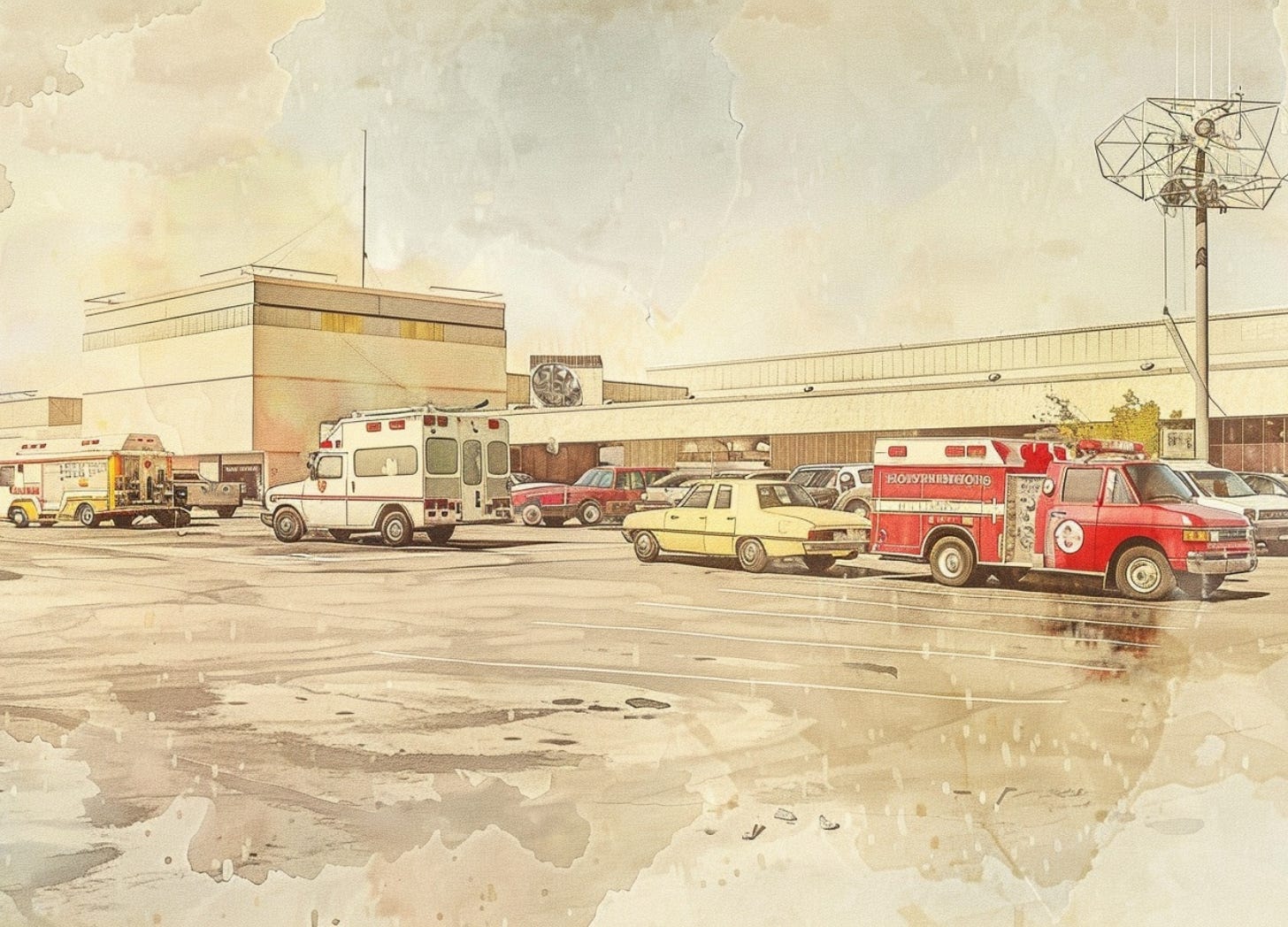
The building was visible from half a block away. The front wall had come in. Not collapsed from age or weather. Come in, like something had made a decision about it. Emergency vehicles filled the lot. Two squad cars. A fire engine sitting idle with no active call to justify it. A news van at the far end of the block, satellite arm up, nobody in front of a camera yet.
Lorin counted twelve personnel visible. Possibly more inside.
He pulled to the curb and cut the engine.
They sat for a moment without saying anything.
“Police got here first,” Merrit said.
“Yes.”
“We’re not getting in there.”
“No.”
They got out anyway. Protocol required a site assessment even when access was blocked. Lorin logged the time and started a slow walk along the perimeter, the kind that looked like a neighbor taking stock. Merrit drifted the other direction, hands in his jacket, doing the same.
The signature was harder to read from the outside. It sat low, close to the structure, like whatever it was hadn’t fully decided to leave. Not projecting. Not dissipating. Just waiting in the walls.
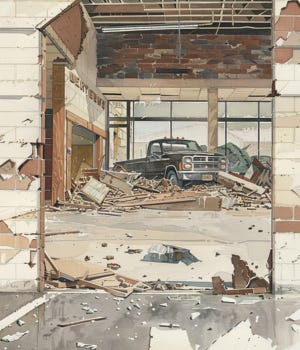
Lorin stopped at the corner of the adjacent lot. From there he could see through the breach into the showroom. Furniture overturned. Debris across the floor. A truck still inside, cab facing out, like it had reconsidered halfway through. The wood from the displays had scattered across the concrete in a pattern that didn’t entirely match the angle of impact.
He looked at the wood for a long time.
The officers were doing what officers did at scenes like this. Photographing. Measuring. One of them was talking to a man near the door with a clipboard, probably the owner, nodding slowly the way people nod when they’re still in the part that hasn’t caught up with them yet.
None of them were looking at the right things.
Merrit came back around and stopped beside him.
“Feel that,” Merrit said. It wasn’t a question.
“Yes.”
“What is it.”
Lorin had been doing this long enough to know most signatures on contact. Construct bleed. Containment failure. Lineage event. Surface contamination. Each one had a texture, a weight, a particular way it settled in the air around a site.
This didn’t match any of them cleanly. It sat adjacent to several at once, like something that had moved through multiple categories on its way to becoming whatever it currently was. Old. Dense. Not aggressive. Not residual either. Present in a way that felt deliberate.
“I don’t know,” he said.
Merrit looked at him.
“Log it unclassified,” Lorin said. “We’ll see if anything comes back on the signature.”
They walked back to the van. Lorin typed the report while Merrit pulled away from the curb.
Incomplete corrective response. Site inaccessible, active law enforcement presence. Perimeter assessment only. Signature anomaly detected, origin unclassified. Materials of note: aged timber, traditional construction methods, long-term site occupancy. Recommend follow-up pending site clearance.

He submitted it and pocketed his phone.
The news van was still there as they passed. Nobody had gone live yet. A producer stood by the side door scrolling through something, waiting for a reason to.
Merrit drove without talking for a while. The river came and went on their left, flat and dark between the trees.
“First time in a while you didn’t know,” he said eventually.
“Yes,” Lorin said.
“That bother you.”
Lorin watched the road.
“Not yet,” he said.
No follow-up was assigned.
AUTHOR’S NOTE
at may season studio, we document the quiet mechanics that hold our world together. the routines, the tensions, and the moments that should not have happened but did anyway. this entry reflects another observation from within our walls.
written and designed by gintare okrzesik, creator of may season studio. a fictional corporation exploring beauty, bureaucracy, and quiet corruption through narrative design.
filed under: corrective operations / from the may season studio employee files
Some calls close cleanly.
This one did not.
Begin with:
The Digging Team
Pattern Interference: Field Follow-Up Report
The Company That Regulates Reality
Then follow the trail.


