

May Season Studio Archives
by Gintare O.
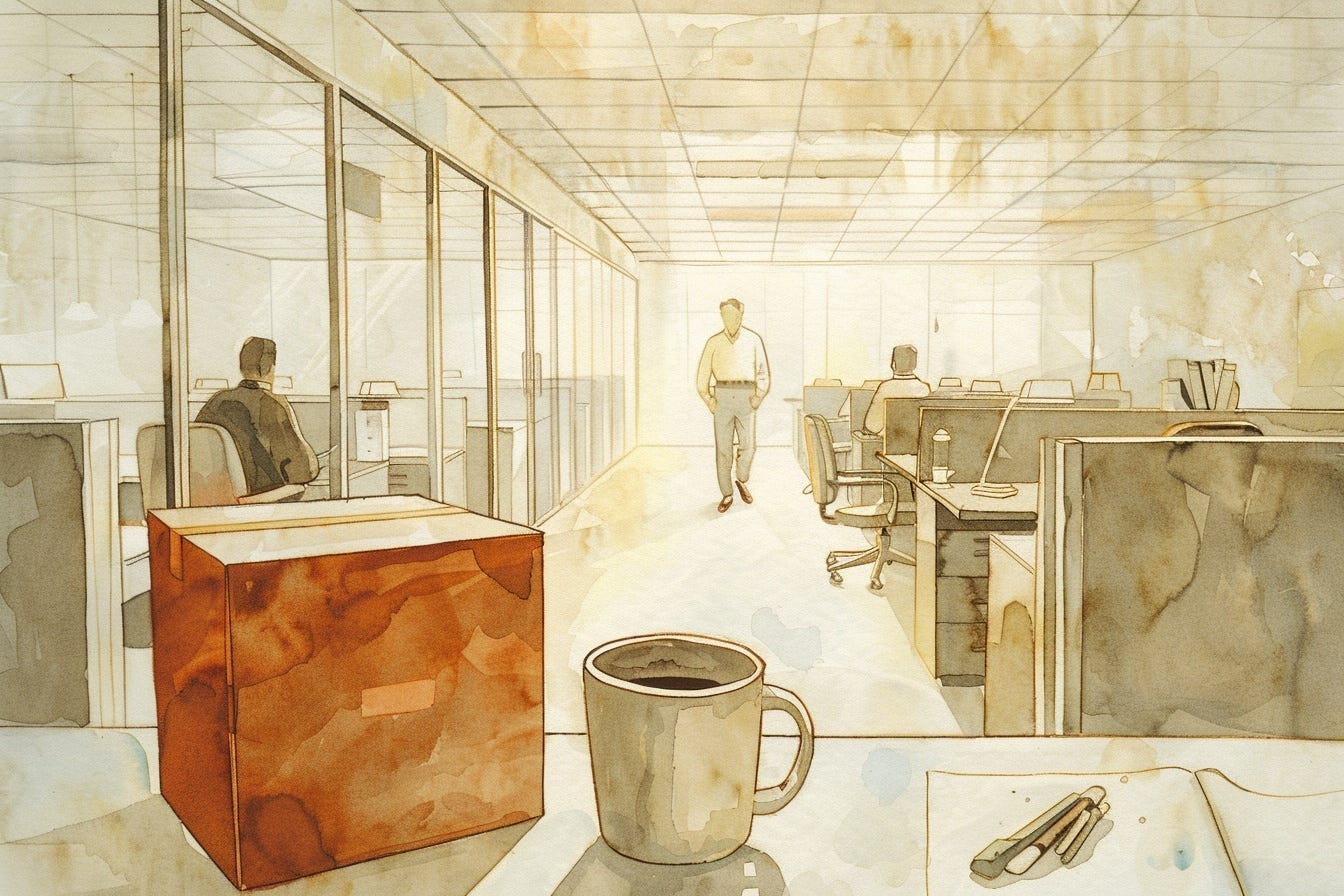
The day always started the same way: fluorescent lights flickering awake, the low hum of monitors, and Karen’s voice cutting through it before my login screen even loaded. She didn’t say good morning; she said corrections. The rest of us adjusted our tone to match her mood. By 8:07 a.m., she’d found a typo, Blake had called it “a great catch,” and the office was already quiet enough to hear the vents breathe.
Every day followed the same template. Log in, rename files, log out, pretend it mattered. Karen said consistency kept the system running, like we were all small screws holding something sacred together. Blake believed her. He called her “steady,” which was just a polite way to say “nothing changes.” I called her nothing at all. Talking to Karen meant she’d remember you.
She remembered me anyway. I was one of the few she couldn’t bully. I did the job and didn’t give her room to push. There was a strange respect in that—an understanding. She was almost nice to me. When I had to talk to her, I played the game: ask for her opinion, flatter her expertise, pretend I couldn’t solve something without her insight. I’d put on my fake personality and push through. Some days I wasn’t sure who was worse—Karen or Blake. At least Blake smiled while he lied.
He was chasing a promotion the same way kids chase popularity: by proximity. He mirrored Karen’s opinions like it was policy. Everyone knew it was fake.
That morning wasn’t any different. I hadn’t finished my coffee and Karen was already lecturing Frank about his product descriptions. “Why didn’t you think to Google it?” she asked. I slipped on my headphones—not to listen to anything, just for cover. There’s something satisfying about hearing drama no one thinks you’re hearing. People are always more honest when they assume you’re tuned out.

Nine o’clock. Team huddle. The most dreaded and, somehow, best part of the day. Karen insists we all share updates “to encourage collaboration,” another corporate initiative no one believes in. I’m not sure what the point is, and neither is she. I once heard her in the bathroom calling it stupid to Christina, her manager, who agreed but still made her run it.
Our job is simple: write product titles, descriptions, and attributes. Keep the catalog current so the system doesn’t break. It’s boring but necessary. Once you learn the formula, it’s easy. I even made a folder of examples to work faster. Karen hated that.
Then again—did Karen like anything?
She demanded uniformity, which, honestly, made things predictable once you figured her system out. I never understood how my coworkers still got caught off guard. Same lectures, same embarrassment, same cycle. For Karen, this department was the company’s backbone. She wasn’t wrong—without us, nothing got logged or named—but someone else would always find another way. That’s corporate life.
I was about to start a podcast and actually get something done when a courier rolled a large box past my cube toward Karen’s. I already knew what it was: unplanned products or a forgotten launch. Either way, I knew the routine—complaining, blaming, and her favorite phrase: “How are we supposed to fit this into our workload?” We weren’t busy.
The courier stopped, backed up, and said flatly, “Oh, almost missed you.” He dropped the box at my feet and walked off before I could say anything.
Before I even stood up, Karen was there, slicing the tape open. What if it was my Amazon order?
Inside: random stationery, tags, party supplies, invitations to events that already happened. Different paper, different fonts, nothing matching. But the smell—sweet, faintly floral, not musty like old paper—stuck with me.

“Ugh, don’t touch anything,” she snapped. “Looks like mismatched items that never got cataloged. Probably prototypes.”
“Want me to call downstairs and have them send it back?” I asked.
“No. I’ll go through them after lunch. Even if we send them back, they’ll just want everything organized first. Not sure why they sent it to you—they should’ve emailed me.” She couldn’t move on without the jab.
She nudged the box toward her cube with her foot. Fine by me. At least it wasn’t blocking mine anymore.
By 11:15, I stood to stretch. My favorite part of the day. I walked the long route to the restroom, then to the break room to grab my lunch. When I came back at 11:30, Karen was packing up. She always went out for lunch—rotating between the same four restaurants like clockwork.
I unwrapped my sandwich and enjoyed the quiet. When she left, the air always changed—lighter, easier to breathe. Even Blake cracked a joke. Everyone laughed just enough. For an hour, the office felt human.
The hour always vanished too fast. By 12:25, we’d all start glancing at the clock, waiting. She never took more than an hour. If she did, something had delayed her—traffic or small talk we’d hear about later.
Sure enough, 12:28. Karen walked in with her takeout container. Instantly, everyone minimized their screens. The smell of her food filled the air.
“Anyone touch this box?” she asked, sharp as always. No one answered. Just the rhythmic clicking of keyboards.
The rest of the day dragged. I worked with a podcast running low, pausing whenever voices rose. At one point, I heard her tell Blake, “No one follows the process anymore. They do whatever they want.”
By 4:45, I was stretching again, taking the long route to the restroom before packing up. We don’t punch in or out, but Karen keeps mental notes of everyone’s hours. At 4:58, I hit shut down. By 5:00, I was out the door.
And for the first time all day, I felt like myself again.
Author’s Note:
At May Season Studio, we believe in consistency, attention to detail, and the quiet despair that holds every workplace together. This entry was inspired by one of our longest-serving employees, who continues to remind us that cruelty doesn’t always require talent—just tenure.
written and designed by gintare okrzesik, creator of may season studio — a fictional corporation exploring beauty, bureaucracy, and quiet corruption through narrative design.
Filed under: product catalog division / from the may season studio employee files — part 1 of 3
"quiet enough to hear the vents breathe."
"He was chasing a promotion the same way kids chase popularity: by proximity."
I did not know what to expect but legit, there is some really good writing in this. Will definitely start combing through more of your archives!
It's funny... I get "The Office" vibe from your pieces, but a "reality" version. On point and realistic. I have time for a few more... :)