

May Season Studio Archives
by Gintare O.
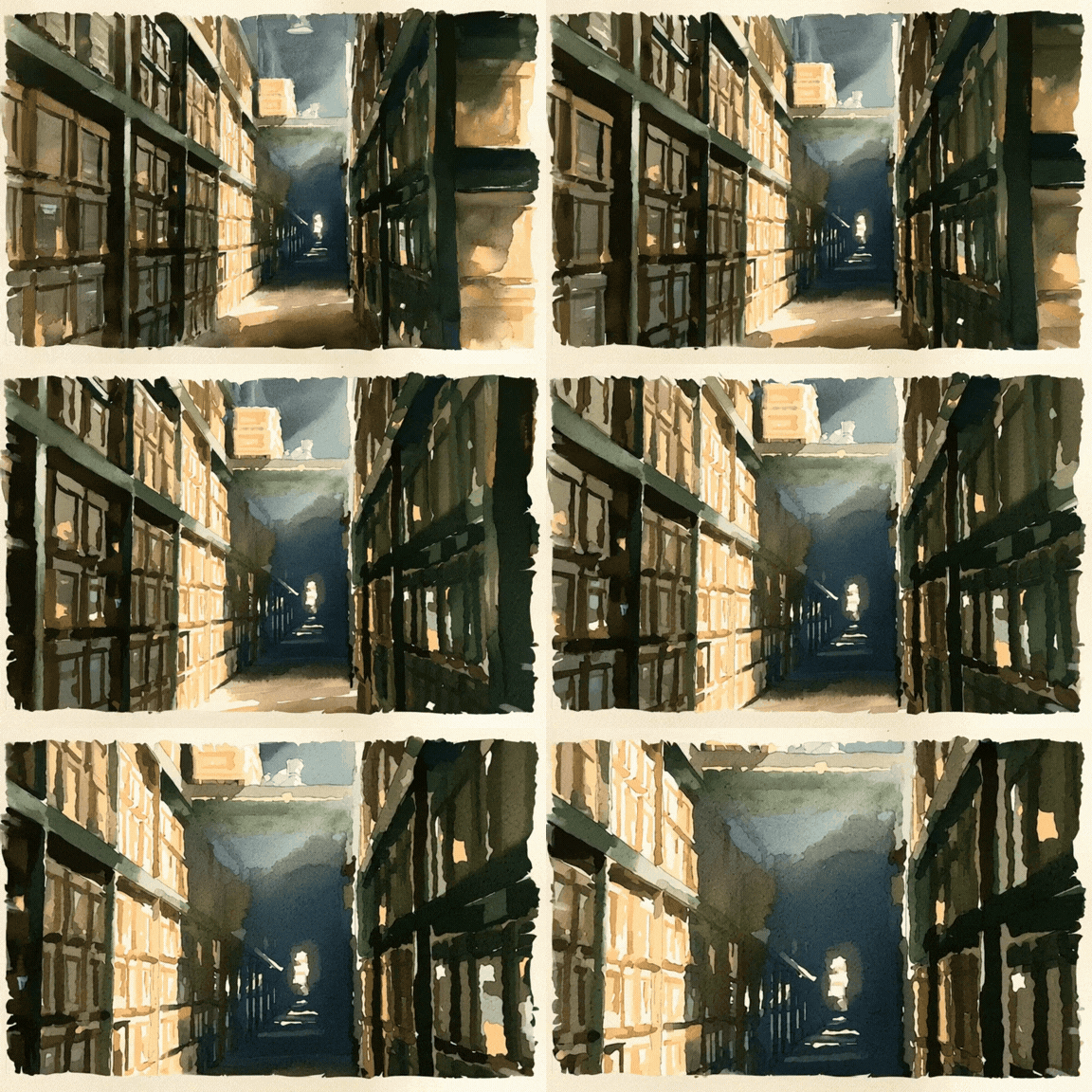
The consolidation was routine.
The storage archive had been running short on usable grid for two years, the way every archive eventually does, and the fix was the fix it always is. Reclaim the middle. The old middle section had been filled in piecemeal over a decade, no numbering logic, crates placed wherever a gap existed, and the new plan collapsed all of it into a clean grid so the space could hold a third again as much.
Nobody who approved the plan had been in the room. There was no reason to be. You did not need to see a shelf to renumber it.
The work went to a two-man facilities crew, Petro and Vance, who had a pallet jack, a scanner, and a printout four hundred lines long. Each line was a crate. Each crate had a current coordinate and a destination coordinate. The job was to make the second match the first, four hundred times, and then go home.
They did not open anything. That was not the job. You did not open archive crates. You scanned the label, you moved the crate, you scanned it into its new slot, and the system marked the line done. The contents were somebody else’s problem from a decade ago and were, per every label, inactive.
They were most of the way through the middle section by the second night.
Line 287 was a crate between a discontinued glassware line and a seasonal décor concept. The label read the way they all read. An inventory number. A date. Three words.
Stored. Indexed. Inactive.
Petro scanned it. The system gave him a destination two aisles over, upper grid, and he set the jack and lifted it.
It was heavier than it looked, and it ticked.
“This one’s ticking,” Petro said.
Vance was four crates down, scanning. “They all do something,” he said. “Old crates settle. Something shifts inside, you get a tick, you get a knock. Glassware’s the worst. You’ll hear it all night if you listen for it.”
Petro stopped listening for it. That was the correct thing to do and it was what the job trained you to do. Four hundred crates. You could not wonder about each one.
He moved it out of the slot, and on the way out the leading corner caught the upright.
It was nothing. It was the kind of contact that happened forty times a night in a tight aisle, a corner clipping a shelf leg, the crate shrugging a half inch on the forks and settling again. Petro felt it through the handle and adjusted and kept going. He did not stop to look because there was nothing to look at. The crate was closed. It stayed closed. It rode to the new slot and he scanned it in and the system marked line 287 done.
What the contact had done was not visible from the outside.
The seal was a single continuous strip around the lid, and the corner strike had lifted one end of it, a hairline, less than the width of the label print. The lid did not open. It settled a millimeter proud on one side, the way a drawer settles when something small is behind it. In a lit room, up close, with a reason to look, you might have caught the thin dark line where the lid no longer met the crate.
There was no reason to look, and the room was not lit where the crate now sat, and Petro was two aisles away scanning line 291.
They finished the section at a quarter past three. Petro logged the consolidation complete on the tablet and the tablet asked whether all lines had been resolved and he confirmed that they had, because they had. Four hundred lines. Four hundred crates. Every one scanned out of its old coordinate and into its new one. The report generated itself and went where those reports go.
Relocated. Indexed. Inactive.
The same three words, near enough. The crate had moved. It was indexed at its new coordinate. And the third word was the one word on the label that was now wrong, and there was no one in the building who could have known that, because knowing it would have required opening the crate, and the entire design of the archive, its whole reason for being, was that nobody ever opened anything.
Petro and Vance rolled the jack back to the dock and clocked out. Vance said something about the ticking one, the heavy one, that it had been a good tick, a clean tick, not a rattle. Petro said old crates settle. They both agreed that old crates settle, which is true, and they went home.
The lights in the middle section shut off on their schedule.
In the dark, on the upper grid, two aisles from where it had spent its years between the glassware and the décor, the crate sat with its lid a millimeter proud on one side.
A millimeter is a gap. A gap is an edge. An edge is where an object ends, and the assessment of where an object ends and the next one begins was the one thing the unit inside had been built, above all else, to do. It had been doing it, patiently, without instruction, keeping time against the day the boundary changed.
The boundary had changed.
The material found the gap the way water finds the low place in a floor, without hurry, without sound beyond the faint continuous tick it had always made, and it came through the hairline at the corner of the lid in a thin bright thread, and it reached the shelf, and the shelf was an object, and the unit began to wrap.
It had a great deal of time and a great deal of material and, for the first time in years, something to finish.
By morning the ticking was no longer the only sound in the middle section, but there was no one in the middle section to hear the difference, and the consolidation was marked complete, and the project remained closed.
The follow-up would come later. It would come as a work order, filed by a facilities tech who found something in an aisle he could not immediately name, routed into a queue, sorted by date, cleared to a different team than the one that had put it there in the first place.
That team had not been told what it was. No one had.
AUTHOR'S NOTE
at may season studio, archive crates are not opened. the label records the status at the time of indexing. the status is reviewed when the crate is opened.
written and designed by gintare okrzesik, creator of may season studio. a fictional corporation exploring beauty, bureaucracy, and quiet corruption through narrative design.
RECOMMENDATIONS
The crate has a history. Most of it is already filed.
Begin with:


The project remained closed.
Optimizing physical space purely from an abstract spreadsheet is the purest expression of bureaucratic disconnect. The people making the decision never have to live with the physical reality of the grid they mandated.
I hear the music from Jaws in the distance. Still faint, but building.