

May Season Studio Archives
by Gintare O.
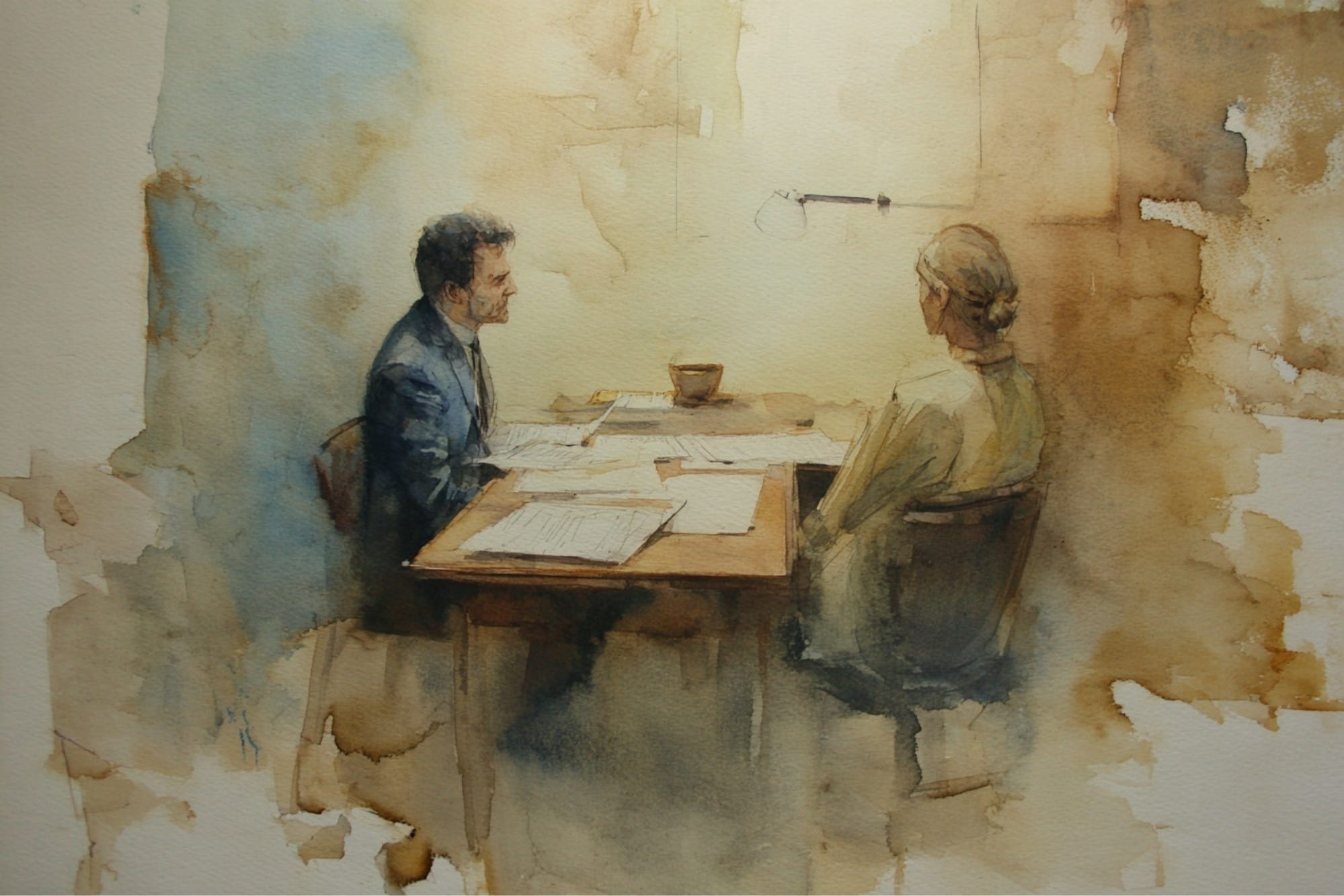
The complaint was filed on a Tuesday.
Hayley Petrosian had been at MSS for three weeks. She was twenty-two. She had graduated in May from a small liberal arts college in Ohio. Her job title was Marketing Coordinator. Her manager was Chad Reynolds. She had been told during her interview that the team was “a great group” and that Chad was “really invested in developing junior talent.”
Hayley did not yet know which corporate phrases meant something and which were structural. She had not yet developed the calibration the women two cubes over had spent four years building. She had no working theory of Chad.
What she had was three weeks of observation.
The staring had started in her second week.
She had assumed, at first, that this was an executive thing. A way of conveying investment in your reports. She had read about this in a book her father had given her at graduation.
She watched Chad in subsequent meetings. She noticed that he did not hold eye contact this way with the male coordinator who had been hired the same week. She noticed he did not hold eye contact this way with the women on the floor over the age of forty.

She noticed that he held it with her. And with a coordinator named Ren. And with a contract designer who had started two days after she did and who was twenty-four and from California.
Hayley made a note in her phone.
By the end of week three, Hayley had eleven notes.
She filed the ticket on a Tuesday afternoon after a one-on-one in which Chad complimented her blazer twice. The first time when she walked in. The second time when she stood up to leave. The compliment was about the blazer. The way he looked at it the second time was not.
She used the word *creepy* once in the ticket and then deleted it and replaced it with *uncomfortable*. She used the phrase *sustained visual attention* because she had read it on the HR intranet that morning while searching for the proper form.
She submitted the ticket. She closed her laptop. She walked to the bathroom and did not cry but did sit on the closed toilet lid for four minutes before going back to her desk.
HR was Diane Loomis.
Diane had been with MSS for eleven years. She had seen Chad’s name on incident logs three times before, each time in connection with a complaint that had been described to her, off the record, as low-grade, or ambient, or, on one occasion, the kind of thing you can’t really do anything about.
Diane read the ticket twice.
She noted, in her private file, that this was the first time the complaint had been filed with documentation. Eleven dated entries, attached as a screenshot, were the kind of contemporaneous record that HR could not dismiss as memory.
She scheduled two meetings.
The meeting with Hayley was careful. Diane asked clarifying questions in the voice HR uses when it has decided in advance not to discourage a complainant. Hayley walked her through the notes. Diane wrote things down.
She asked whether Mr. Reynolds had said anything inappropriate.
Hayley said no.
She asked whether he had touched her.
Hayley said no.
She asked whether he had made any direct comments about appearance.
Hayley said he had told her, on Monday, that she had a really expressive face. He had said it while she was eating a granola bar.
Diane wrote that down.
The meeting ended. Diane thanked her. Hayley returned to her cube and worked through her queue and did not look at Chad’s section of the floor for the remainder of the day.
The meeting with Chad was less careful.
Chad arrived eight minutes early with a coffee. He sat down and asked Diane what was up. He did so in the tone of a man who had not been told what the meeting was about and who assumed that whatever it was, it would be fine.
Diane explained that a member of his team had raised a concern regarding sustained visual engagement.
Chad blinked. He asked her to repeat that.
Diane repeated it.
Chad laughed. Not maliciously. Genuinely. The kind of short, baffled laugh a person produces when they have just been told something they cannot fit into their model of themselves.
He asked if someone had reported him for *looking* at them.
Diane said the concern was the duration.
Chad said he was a people person and that looking at people was his job.
Diane said the concern was that the looking extended past the point of conversational utility, that it was directed primarily at women on the team under the age of thirty, and that it occurred alongside comments about appearance that, while individually unremarkable, accumulated into a pattern.
Chad stared at her.
Diane timed it privately.
Nine seconds.
She added a note.
Chad asked who had reported him.
Diane said she was not able to share that.
Chad said it was Hayley.
Diane said she was not able to share that.
Chad said Hayley had been kind of a project. That he had been trying to develop her.
Diane wrote that down too.
The conversation lasted forty-six minutes. By the end of it, Chad understood, in the specific and limited way Chad understood things, that he had been Talked To. He understood the Talk had not resulted in formal discipline. He understood there was no note going in his file beyond what Diane termed an informal coaching record. He understood he was expected to modify his behavior.
He did not understand what behavior he was modifying.
He asked Diane, at the end, whether she could give him a clearer example.
Diane said to reduce the duration of direct eye contact in one-on-one settings, particularly with newer employees.
Chad said, “So just... don’t look at them?”
Diane said, “Look at them appropriately.”
Chad said, “What’s appropriately?”
Diane said, “Less.”
Chad left the meeting and went directly to his cube and sat down and stared at his monitor for approximately twenty minutes without doing anything, which was the longest period of sustained visual engagement he had performed in the office in eight years.
The week that followed was difficult for everyone.
Chad did not look at Hayley. Chad did not look at Ren. Chad did not look at the new contract designer. Chad looked, instead, slightly to the left of each of them, at a fixed point on the wall, with the focused intensity of a man trying very hard not to do something he did not understand he had been doing.
On Thursday, Chad approached Hayley at her desk. He told her, in what he believed was a professional and corrective tone, that he took this very seriously and was working on it. He told her he valued her as a team member. He told her he wanted her to feel safe.
Hayley said thank you three times without looking up.
She filed a second ticket within the hour.
Two weeks later, the policy appeared on the intranet.

**HR Advisory: Sustained Visual Engagement in Professional Settings.**
Four pages. Carefully worded. Exhaustive.
It defined visual engagement.
It defined sustained.
It distinguished between conversational eye contact, attentive listening behavior, and what the policy termed non-verbal pattern conduct. It included a section on appropriate compliments. It included a section on inappropriate compliments. It noted that a compliment about an article of clothing should not be repeated within the same conversation, and that compliments regarding facial expression, posture, or demeanor were generally discouraged in cross-tier interactions.
It defined cross-tier.
It included a footnote on avoidance behavior that was almost certainly written about Chad.
No one was named.
Hayley read it at her desk and forwarded it to her mother with the subject line *they wrote a whole document about him*.
Chad read it at his desk. He read it twice. He did not understand the footnote. He sent Diane a Slack message asking whether the policy was about him.
Diane did not respond.
Chad kept his job.
He hit his Q3 numbers.
In November, he was given a small commendation at the all-hands for leading with consistency through a period of internal recalibration. He thanked the senior VP. He said it had been a great learning experience.
In February, he was promoted to Senior Director. The announcement described him as a values-driven leader who had demonstrated exceptional growth. It included a quote from Chad in which he said his recent journey had taught him the importance of psychological safety on his team.
Hayley read the email at her desk. She did not forward it to her mother.
In March, Chad launched a mentorship program for newly hired women on his team. The first cohort had four participants. All four were under twenty-five.
In April, he told the story at an offsite as a personal growth moment. He said he was grateful to the person who had raised the concern, though he could not name her, he added with a small laugh, due to confidentiality.
Several people clapped.
Hayley had taken the day off.
The floor returned to normal.
Which was to say, uncomfortable in quieter ways.
AUTHOR’S NOTE
the bureaucracy here is not failing. it is working exactly as designed. it produces a response. the response is a document. the document changes the air on the floor slightly. chad keeps his job. that gap, between what gets written down and what actually changes, is where the story sits.
written and designed by gintare okrzesik, creator of may season studio. a fictional corporation exploring beauty, bureaucracy, and quiet corruption through narrative design.
Filed Under: human resources / from the may season studio employee files
Some incidents become policies.
The policies stay on the intranet.
Begin with:
Personal Care Clarification
Exit Interview: Surface Division
The Company That Regulates Reality
Then follow the trail.


What stayed with me is how the problem never truly disappears. It changes language, becomes a procedure, becomes a document, yet continues to inhabit the same spaces. A quiet transformation that somehow leaves almost everything exactly where it was.
Oh Chad, you devil, you. This is true to how things work at big corps. For men anyway.