

May Season Studio Archives
by Gintare O.
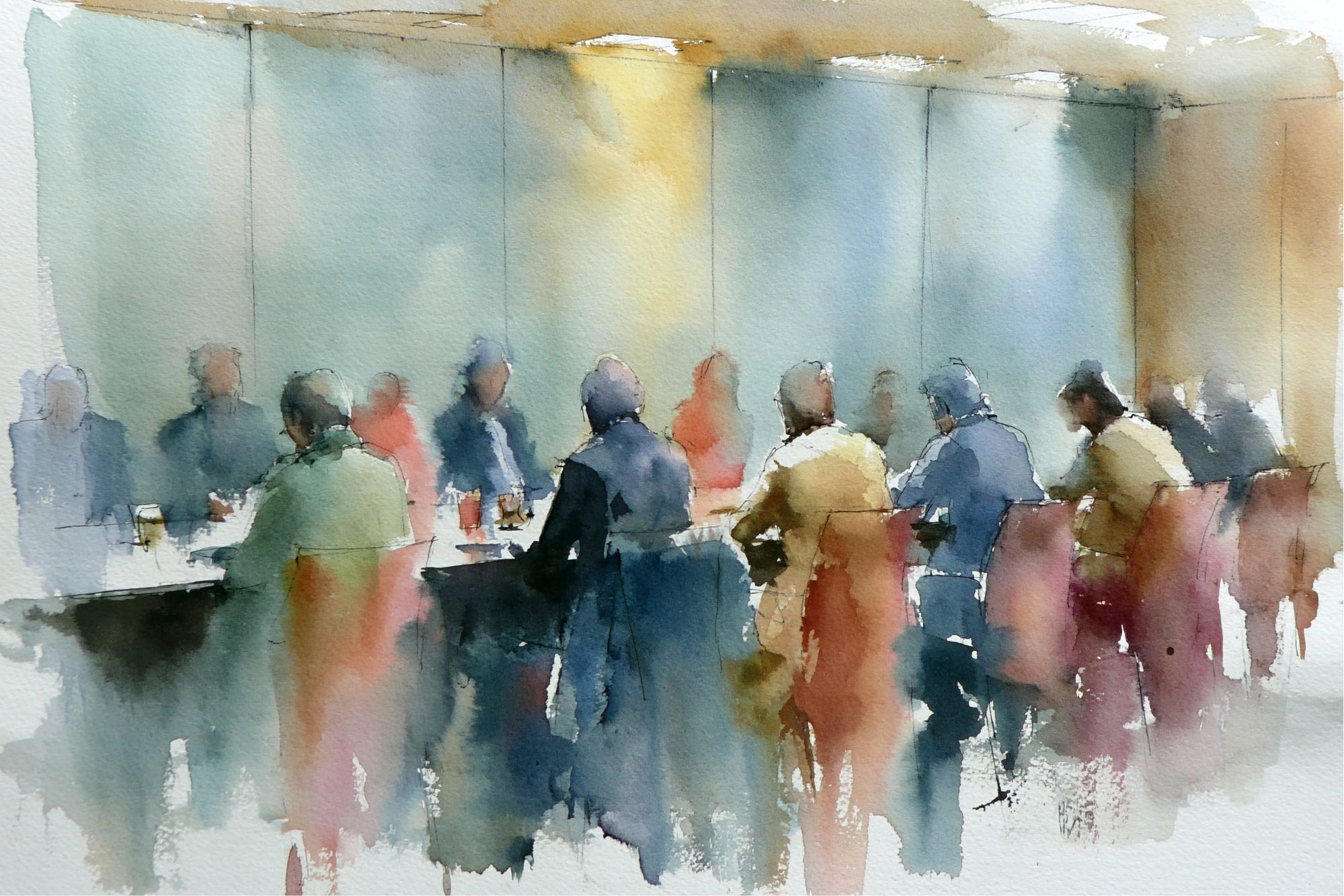
The meeting was scheduled for ninety minutes and had three items on the agenda. Only the first was ever reached.
The room was on the fourth floor of the personal care division, the long one with the frosted glass wall facing the corridor. The directors arrived first, the way the prepared arrive first. Daniel Vance and Renata Carrow sat on the window side with their laptops open and their printouts squared. Samuel Okafor and Greg Brandt sat across with nothing in front of them, there to listen and vote with whoever made the better case. The two senior managers, Wendy Liu and Anthony Demarco, took the chairs along the wall, which is where senior managers sit when the voting members are vice presidents. The cost analyst, a man named Eli Petrie who had been with the company under two years, set up by the screen and tested the clicker twice.
The recording secretary sat in the corner by the door. Her name on the distribution list was Grace Acer. She was on loan from another floor for the quarter and had been told it would be three meetings. This was the first. She wrote the date at the top of a legal pad and waited.
The three voting members came in together and came in last. Ray Pell from Operations, heavy and unhurried. David Asher from Supply, who held the door for Liu on his way in. Marian Iqbal from Finance, who sat and folded her hands on the empty table in front of her. None of them brought materials. Asher asked Petrie if he was ready. Petrie said he was.
There were three items. Base material substitution for the Halloran personal care line. Packaging consolidation for the refillable vessel. Freight renegotiation for the first quarter. Acer wrote all three at the top of the page. She would draw a line through the bottom two before the morning was over, unstarted.
Petrie presented the first. He did not oversell. He built the case one fact on top of the next.
“The Halloran base has used one clay, from one supplier, since 1904,” he said. “It is sole-source. The contract has never been competitively bid. Not once. There is no bid event on file, ever, for this input.” He advanced the slide. “Here is what we pay. Here is what comparable cosmetic clays cost on the open market. We are paying between nine and fourteen times the going rate.”
He let the two numbers sit side by side before he moved on.
“I did the work before coming in here,” he said. “Three candidate substitutes. All cosmetic or food grade, fully documented, all from vendors already on our approved list. No onboarding, no new audit, no lead time. We could order this quarter.”
A table came up, four columns.
“I commissioned independent lab testing first. The current base in column one, the three candidates beside it. pH. Lather. Hardness. Cure time. Skin irritation index. Shelf life.” He looked at the room. “They match to three decimal places on every property the lab can measure. We tested blind. The lab could not identify the incumbent. There is no instrument we have access to that tells the current base apart from any of these three.”
Vance leaned forward. “Say the savings number.”
Petrie put it on the screen. Acer wrote it down and will not reproduce it here, because she was later asked not to, but it was larger on its own than the entire cost reduction target the division had been handed for the quarter.
“That is annual,” Petrie said. “Recurring. After a small year-one validation cost, which I have already netted out, it is clean savings, indefinitely, with no measurable change to the product.”
He thanked the board and sat.
Vance spoke first, because Vance was always going to speak first.
“In eleven years on review boards I have not seen a cleaner case,” he said. “Sole-source at fourteen times market. No competitive bid in the history of the company. Three replacements the lab cannot tell apart from the original. A savings number that closes our target and then some. I move we approve the substitution. If anyone has reservations about a straight switch, I will amend the motion to this: approve a competitive bid on the input. Just put it to market. We are not even obligated to act on the bids. I cannot construct an argument against asking.”
He looked down the table.
Asher said, “No to both.”
He said it without weight, the way a man declines a second helping. He was not cold. He had held the door on the way in.
“On what grounds,” Vance said.
“The base formulation is not eligible for substitution,” Asher said. “It is not a change this board can approve. That is not a reflection on the work. The work is excellent, and Eli should hear that plainly. But the base was never on the table. I should have caught it on the agenda and pulled the item.”
Carrow spoke. “There is no documented exception for the base. Daniel looked. I looked. I read the change control policy front to back last night. No carve-out, no exclusion. By our own governing policy it is in scope, and a clean cost case in scope gets a vote.”
“You read it correctly,” Asher said. “There is no exception in the policy.”
“Then it is in scope.”
“It is not eligible,” Asher said again, and added nothing after it, and the absence of anything after it was the loudest thing that had happened in the room.
Carrow tried another door. “Is there a quality concern the lab missed. A field complaint history. Anything.”
Pell answered from the far end. “No. The lab is right. A customer could not tell the bars apart either. There is no quality argument, and I want that on the record so nobody leaves thinking we hid behind one.”
“Then it is contractual,” Carrow said.
“Yes,” Asher said.
“We have broken worse contracts than a soap input and paid the exit fee and come out ahead. Show us the agreement. Let procurement and legal look at the exit terms.”
“I cannot show you the agreement,” Asher said. “It is not held at the division. It is not held at the corporate level either, not where you would look for it. It is an executive-level instrument. A heritage contract. It predates every person in this room and most of the org chart above us, and it is administered somewhere I have never been given visibility into.”
“Who has visibility,” Carrow said. “Who can authorize a review.”
Asher was quiet for a moment. The fluorescent panel over the table had a flutter in one tube that no one had fixed.
“I do not know,” he said. “I asked that question once, when I first sat in this chair and the same item crossed my desk and I made the case Daniel just made, almost word for word. I did not get an answer I could use. I asked once. I did not ask again.” He said it the way a person describes the weather in a country he used to live in. “I would advise you not to spend much of your career on it.”
Acer wrote that down too.
The room went quiet for a period she did not time. Petrie looked at his own screen, where the table still sat, identical to three decimal places. He had the expression of a young person discovering that being right was not the currency he had understood it to be.
Vance made one more attempt, and it was the correct one.
“Let me ask it as cleanly as I can,” he said. “Does anyone at this table dispute a single number Eli put on that screen.”
No one did.
“Then I want the record to show what we are doing. We are choosing, with full knowledge and unanimous agreement, to leave that figure on the floor. This year. Every year. For a reason not one of the three people in this room with a vote will say out loud.”
Iqbal said, “Yes.”
It was the first thing she had said. She was Finance. Of the three, the number on the screen should have cost her the most sleep, and she confirmed leaving it on the floor as evenly as if she were confirming the date of the next session.
“I have voted that way every year I have sat on this board,” she said. “Six years. When it becomes your turn to sit in one of these chairs, and it will, because they move good directors up and you are a good director, vote the way I am voting today. Do it without spending the years on it that some of us spent.”
“Why,” Vance said.
Iqbal looked at him. Acer watched her decide not to answer.
“That question has been asked,” Iqbal said. “It is in the minutes from before my time. Go and read it. You will find the asking. You will not find the answer. There has never been an answer entered into a record. I have come to understand that the absence is the answer, and that I am better at my job for having stopped looking for a different one.”
The board declined the substitution. The board declined the competitive bid. No grounds were entered. The three voting members were unanimous, and they were unanimous quickly, and not one of them looked uncomfortable, which was the part Acer kept returning to afterward. They were not concealing something they were ashamed of. They were observing something they had stopped fighting.

Asher thanked Petrie a third time, told him the analysis was the best the board had seen in years, that he should be proud of it, and that none of it would go anywhere. He said the three things in one breath and they did not appear to contradict one another in his mind.
Petrie began to pack his bag. Liu leaned over from the wall and said something to him too quietly for Acer to hear. Petrie nodded. He opened his laptop again and, while still in the room, deleted the file with the three substitutes from the shared drive. A moment later Acer was asked to confirm the file had been removed. She confirmed it, and wrote in the minutes that it had been removed and that she had verified the removal, because leaving it out would have been adding nothing in, and adding nothing in was the whole of her reputation.
Items two and three were carried to the next session.
The meeting had been scheduled for ninety minutes. It ran the full block and forty minutes past it, all on the first item. At the end of it the company would go on buying the same clay from the same supplier at fourteen times the market rate, the way it had since 1904, for a reason four intelligent directors had now watched three intelligent vice presidents agree, without visible difficulty, not to know.
Acer typed the minutes that afternoon. They were four paragraphs. They left nothing out and added nothing in. She still uses the soap. It is very good soap. That had never been in question. It was, if anything, the only thing in the room every person present had agreed on.
AUTHOR’S NOTE
at may season studio, every cost case receives a full and fair hearing. most inputs are eligible for substitution. the list of inputs that are not eligible does not exist, and it is reviewed annually.
written and designed by gintare okrzesik, creator of may season studio. a fictional corporation exploring beauty, bureaucracy, and quiet corruption through narrative design.
Filed Under: personal care division / from the may season studio employee files
The contract predates everyone in the room. The minutes only go back so far.
Begin with:
Origins: The Redfield Compact and the First Delivery
Halloran & Co. - The Autumn Edit
Product Feedback Response


On a re-read, this was even better. Such a surreal world you've built here.
I feel like I’ve been in these meetings many times. “I have this great idea! Here’s all the reasons to do it! Want to?” Execs: “but that’s not how we do it…”. Great piece.