

May Season Studio Archives
by Gintare O.
preceding file: Business Case: Wrap-Assist L12 / the program the committee approved in eleven minutes, and what happened to it that June
The test was scheduled for four and ran late. That is why there was only one person in the room.
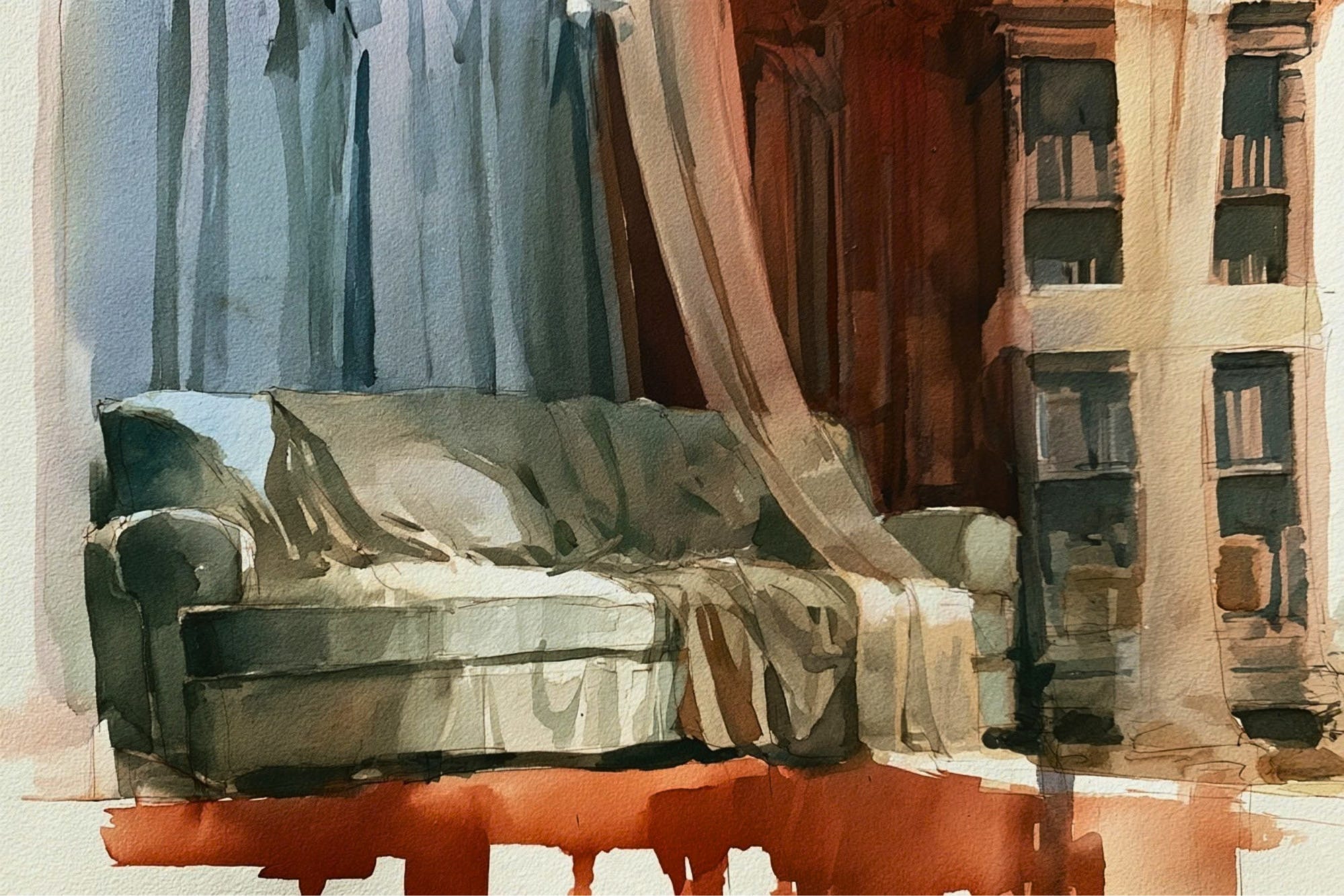
The Joliet facility had a demonstration space on the east side, built the year before for this kind of work. It was a living room. Couch, rug, coffee table, floor lamp, a bookshelf with books on it, curtains on a window that faced the rest of the warehouse. There was no outside on the other side of it. Consumer Innovation had specified the room. Facilities had built it. You could not evaluate a countertop appliance in a lab. You had to put it where it would live.
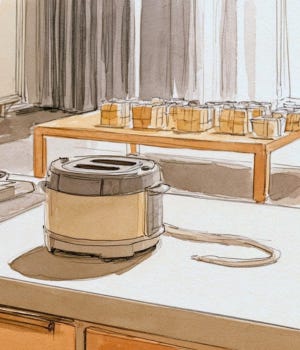
A counter ran along one wall with a cabinet above it. Unit six sat on the counter, one of thirteen Wrap-Assist L12 prototypes built that spring for the Joliet testing cycle. The program had been approved in February. This was the summer bench run, ahead of a fall manufacturing commit that was not supposed to move.
Tom Bailey was twenty-six and had been at the company fourteen months. He reported to Mark Sullivan, who reported to Diane Foster, who owned the program. His title was test engineer. He ran the sequence someone else wrote and logged what happened.
That afternoon was coverage validation on irregular objects. Nine objects, each placed in the recess, wrapped, photographed, measured, logged. He had done seven. They sat on the coffee table in a row, wrapped, immaculate.
Mark left at four twenty for a call. He told Tom to finish the last two and go home.
Object eight was a bicycle helmet.
Tom placed it in the recess and stepped back. The unit began the way it always began, without a sound. Material fed. The helmet turned. The wrap came up over the shell and the vents and closed at the crown. Tom was writing it down when he noticed the unit had not stopped.
The helmet was covered. He could see that it was covered. The unit kept feeding.
He waited eleven seconds. He knows it was eleven because the room camera was running. Then he reached in.
He told Legal, twice, that he reached in to remove the object. That is true. It is not the whole truth. He reached in the way anyone reaches into a machine they do not understand, which is without a plan.
The unit assessed his hand.
There is no evidence, in the footage or the logs, that it made a decision. It did not pause. It did not change modes. There was no error state, then or at any point in the next forty minutes. That fact would matter more than any other, later, to more people than Tom.
It had a new object.
The wrap went up his forearm in under two seconds. Fast, neat, not tight. That was the part he could never make anyone understand afterward. It did not squeeze. It did not hurt. It also did not stop.
He pulled. The material did not tear and did not stretch. It came with him, and the unit fed more to compensate.
He got his arm out of the recess and the unit came with it, off the counter and onto the floor, still feeding.
Tom said a word. It is on the audio.
He backed into the coffee table and went down. The wrap reached his shoulder. He got his other hand on the housing and found nothing to grip. No button, no seam, no switch. The absence of controls had been the product’s best feature.
He rolled. The wrap took the rug.
After that it was no longer about him. The rug was an object, soft-sided and irregular, touching a partly wrapped object. The unit assessed the whole of it and continued.
The rug went in under thirty seconds. Then the coffee table, because the rug was under it. Then the seven finished objects on top of the table, wrapped again. Then the couch. Then the floor lamp, which fell and was wrapped where it fell. The light stayed on inside it for a while. Then it went out.
Tom was against the bookshelf by then, his arm, shoulder and half his chest covered, his legs still working. He stood up. He said later he was never held, that he could move the whole time, and that this was the worst part. The wrap kept up with him. It did not restrain him. It went along.
The bookshelf went next, book by book. The unit had time.
He made it to the door. The handle was already wrapped. The wrap had reached the wall, and the wall touched the door.
He turned around. The wrap was climbing the walls in an even spiral. The curtains were half gone. He told Legal it looked beautiful. Legal took that out of the account.
There was a fire alarm pull on the east wall. He could not reach it. He shouted. The room had acoustic treatment, because Consumer Innovation had asked for it, because you cannot evaluate a countertop appliance with warehouse noise in the room.
At four fifty-one a facilities tech named Gary Patterson walked past to check a filter. He saw metallic ribbon coming out from under the door.
It took Gary and two others eleven minutes to cut Tom out with box knives. The knives worked. The material released cleanly. It was engineered to. A recipient should never struggle with the wrap.
Tom walked out on his own. No cuts. No bruising. Nothing broken. The intake exam that evening found him uninjured.
The unit was still working when they left the room. It had the ceiling to do.

MEMORANDUM
To: D. Foster, Consumer Innovation; M. Sullivan, Engineering
From: Office of the General Counsel
Re: L12 Program, Preliminary Liability Assessment
Privileged and Confidential. Attorney Work Product.
This memorandum summarizes our preliminary assessment of the company’s exposure from the June 14 event at the Joliet testing facility. It is not a safety analysis. We recommend Engineering commission one.
1. Employee exposure. Minimal. Tom sustained no physical injury. Intake exam that evening was unremarkable. We anticipate no workers’ compensation claim. He has returned to duty.
2. The employee’s account. We interviewed him twice. His account is consistent, credible, and, in our assessment, unusable. He describes the unit’s behavior in terms that attribute intention to it. He calls the event beautiful. He says repeatedly that he was never restrained and that the unit accompanied him. Under cross-examination this testimony would harm the company, not because it is false, but because it is vivid. We recommend no further statements and no additions to the two existing interviews.
3. Root cause. There is none, and this drives everything below. Engineering confirms no malfunction, no error state, no deviation from spec, no defect in materials or workmanship. The unit performed within design parameters for the full event. Every log is clean.
A defect can be corrected and disclosed. A product that works exactly as designed and produces this outcome cannot be called defective, and therefore cannot be called fixed. We could not support any representation that the issue has been resolved.
4. Design record. This is our main concern.
The February business case states, at section 5, that the unit “feeds material continuously until the object is fully covered” and that “the wrap completes when the wrap is complete. The unit determines this internally.” It states that consumption is “not consumer-controlled” and calls this favorable. Section 12 describes the product as “a machine that decides on its own how much material it needs, and it decides generously, and it never stops until it is done.”
We understand the length setting was removed as a deliberate engineering decision, documented in the same materials. We could not argue a safeguard was overlooked. We would be arguing it was considered, costed, and removed because its absence improved cartridge attach rate. We do not recommend making that argument.
5. Disclosure. No regulatory disclosure obligation applies at this time. The event occurred at a company facility, involved a company employee, and involved a product not yet in commerce. That changes at first retail sale.
6. Recommendation. Counsel recommends the L12 program not proceed to manufacture.
This is a program decision, not a legal one. We can say we see no version of this product we could defend after an event like this in a consumer home, and based on the design record in section 4, we consider that event likely, not merely possible.
7. Records. Pending the program decision, the demonstration space footage, the unit logs and the two interviews should be preserved and access-restricted. The program’s working documents should not be edited. There is no version of this in which the February business case is improved by revision. There are several in which the attempt is fatal.
We are available at the committee’s convenience.
The program was reclassified from innovation to liability the following week.
Tom Bailey was moved off L12 and onto a packaging concept two floors up. He was told it was a lateral move. It was. He kept the job another year and then he didn’t.
The thirteen units were crated and shipped to storage at the Joliet facility. The power was cut. They sat against the far wall behind quarantine tape until somebody in Corrective Operations got an email about them, months later, at 7:42 in the morning.
AUTHOR’S NOTE
at may season studio, product testing happens in rooms built to look like nowhere in particular. this entry documents what happened when a countertop appliance approved in eleven minutes was left alone with an engineer for the length of one afternoon. the business case called the absence of controls the product’s best feature. this is the afternoon that tested that claim.
written and designed by gintare okrzesik, creator of may season studio. a fictional corporation exploring beauty, bureaucracy, and quiet corruption through narrative design.
RECOMMENDATIONS
Before the paperwork, there was the afternoon that produced it.
Begin with:


Ah! I have been waiting to get back to the wrappers. This was a bit terrifying. Can't wait to see what comes of this: "They sat against the far wall behind quarantine tape until somebody in Corrective Operations got an email about them, months later, at 7:42 in the morning."